FOURTH OF JULY Our offices will be closed on Fri 07/03 in observance of Independence Day. Rentals due back on that day will be extended until Mon 07/06.
Mirrorless cameras have quickly become the standard in modern photography and video production. DSLR systems that once dominated the market, led by Canon and Nikon, have given way to a rapidly expanding mirrorless ecosystem that now includes Sony, Fujifilm, Panasonic, and others. If you're still shooting DSLR and considering switching systems, renting is one of the easiest ways to compare setups before making a long-term investment.
Mirrorless cameras are no longer the new option, they're the direction the industry has moved. Designed to combine the image quality and flexibility of DSLRs with a more compact and capable form factor, they've made a meaningful impact on both photography and video. At Aperturent, this shift is reflected directly in our inventory, which has evolved alongside the industry to keep pace with what professionals and creatives are actually using on the job.
Size and Weight: Mirrorless cameras are generally more compact and lighter than DSLRs, making them well suited for travel, street photography, and situations where portability matters. It's worth noting that as flagship mirrorless bodies have grown more capable, they've also grown in size — some are approaching DSLR dimensions. But across the board, the form factor advantage remains a real benefit for most shooters.
Lens Compatibility: With adapter support for DSLR lenses on mirrorless bodies, shooters have access to a wide range of glass across systems. This opens up creative and technical options that weren't previously available without committing to a single ecosystem.
Silent Shooting: Most mirrorless cameras include a silent shooting mode, which is a significant advantage in settings where shutter noise is disruptive — weddings, events, journalism, and wildlife photography being the most common examples.
Autofocus: Mirrorless autofocus has advanced considerably, with on-sensor phase detection, subject tracking, and eye detection now standard on most current bodies. The result is faster, more reliable focusing across a wide range of shooting conditions, including challenging light.
Focus Peaking: Focus peaking has been available in DSLRs for some time, but the combination of that technology with the improving quality of mirrorless LCD screens makes manual focus more precise and practical than ever — a real benefit for shooters who prioritize tack-sharp focus or work with manual glass.
EVF and LCD Screens: Electronic viewfinders provide real-time exposure feedback, which removes a lot of the guesswork from the shooting process. Being able to see the effect of your exposure settings before you take the shot is a meaningful workflow improvement over the optical viewfinder approach.
Features like real-time exposure preview, improved autofocus tracking, and stronger video capabilities are a big part of why mirrorless systems have become the default choice for many new productions.
What are the drawbacks?
Battery Life: Mirrorless cameras draw more power than DSLRs due to the constant use of the EVF or LCD screen, which results in shorter battery life. For extended shoots, it's worth renting an extra battery or two. We make it easy to add batteries to your order — we'd especially recommend this for wedding photographers, full-day productions, or anyone with limited access to power.
Lens Compatibility: Adapters work well in most cases, but not all DSLR glass performs optimally on a mirrorless body. Older lenses are sometimes better paired with the DSLR bodies they were designed for. Mirrorless systems are best utilized with lenses built specifically for those mounts, which also offer features like in-lens exposure compensation, autofocus mode control, and more.
Size and Weight: The smaller body size is a pro for many shooters, but a con for others — particularly those pairing a mirrorless body with large telephoto lenses, or those who simply prefer the feel of a larger camera in hand.
Mirrorless and Video
Video has always pushed the boundaries of camera technology, and mirrorless has become the format of choice for video production at virtually every level. Many current mirrorless bodies offer 4K and even 8K recording, combined with in-body stabilization, advanced autofocus, and subject tracking — features that were previously reserved for high-end cinema cameras.
The result is that filmmakers, content creators, and professional videographers now have access to a compact, capable, and affordable setup that can handle serious production work. Whether you're shooting for YouTube, a branded campaign, or a full-scale production, today's mirrorless cameras are built for it.
TOP MIRRORLESS RENTALS AT APERTURENT
Take a look at what's always leaving in those black boxes.
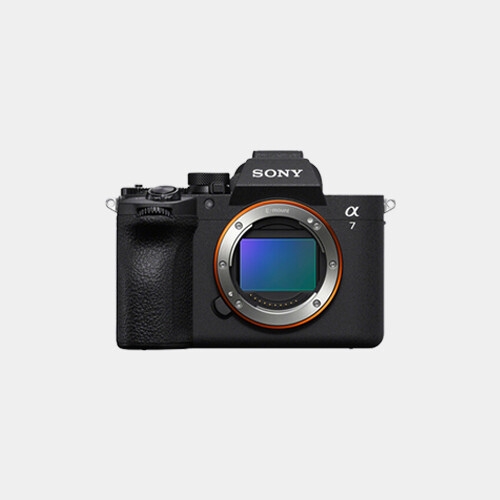
Sony Alpha a7 V: The a7 V is Sony's latest full-frame hybrid mirrorless and one of the most well-rounded cameras in our inventory. Built around a new 33MP partially-stacked Exmor RS sensor with a BIONZ XR2 processor, it delivers 16+ stops of dynamic range, an ISO range of 50-204,800, and continuous shooting up to 30 fps with pre-capture support. Autofocus uses a dedicated AI processing unit with 759 phase-detection points covering 94% of the sensor, with subject detection and tracking for humans, animals, birds, insects, vehicles, and more. On the video side, it records full-width 4K 60p oversampled from 7K, 4K 120p in Super 35 crop mode, and 1080p at up to 240 fps, with S-Log3, S-Cinetone, and real-time LUT support. In-body stabilization reaches up to 7.5 stops. A strong all-around choice for photo and video work.
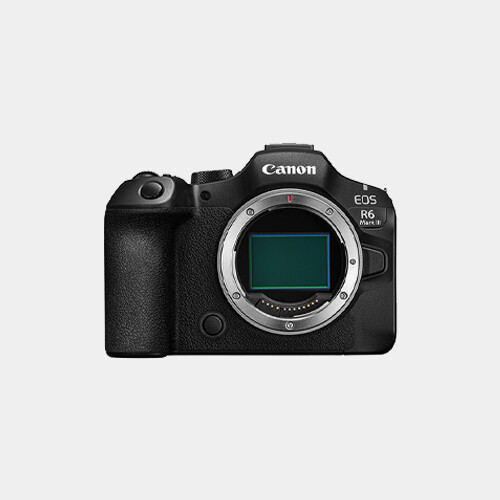
Canon EOS R6 Mark III: Canon's latest mid-range full-frame mirrorless, and a significant step up from the Mark II. The new 32.5MP CMOS sensor — shared with Canon's Cinema EOS C50 — pairs with DIGIC X processing to deliver up to 40 fps electronic shutter shooting with 20-frame pre-capture, and 12 fps with the mechanical shutter. Video capabilities have been substantially upgraded, with 7K 60p 12-bit Canon RAW Light internal recording, open gate 7K 30p, and 4K 120p. In-body stabilization reaches 8.5 stops at center frame. Autofocus is handled by Dual Pixel CMOS AF II with deep learning subject tracking, and the card slots now accept both CFexpress Type B and SD UHS-II for flexible storage. A well-rounded hybrid body that competes at the top of its class.
Canon EOS R5 Mark II: Canon's high-resolution professional hybrid, built around a new 45MP full-frame backside-illuminated stacked CMOS sensor with DIGIC X and DIGIC Accelerator processing. The stacked design enables up to 30 fps electronic shutter shooting with pre-capture, and 12 fps mechanical. Autofocus builds on Dual Pixel Intelligence AF with deep learning subject recognition, and introduces Eye Control Focus — a uniquely intuitive focusing tool that uses gaze detection to select subjects. Video capabilities include 8K 60p RAW internal recording and 4K from oversampled 8K capture, with Canon Log 2 for wider dynamic range. In-body stabilization reaches 8.5 stops. Dual card slots accept CFexpress and UHS-II SD. A serious professional body for photographers and filmmakers who need maximum resolution and video performance.
Sony Alpha a7R V: Sony's high-resolution full-frame option, built around a 61MP Exmor R BSI CMOS sensor and BIONZ XR processor. It shoots up to 10 fps and records UHD 4K30 video, with Real-time Eye AF, Tracking AF, and a Fast Hybrid AF system with 567 phase-detection points. The ISO range runs 100-32000, and 5-axis SteadyShot INSIDE stabilization reduces camera shake by up to 5.5 stops. For shooters who prioritize resolution above all else, this is the camera to reach for.
Nikon Z8: The Z8 brings Z9-level performance in a more compact and portable package — making it the natural entry point for Nikon shooters moving into the mirrorless ecosystem. It uses the same FX-format 45.7MP BSI stacked CMOS sensor as the Z9, delivering high resolution, fast readout, excellent clarity, and strong high-ISO performance up to ISO 102400. The stacked sensor design minimizes rolling shutter, and the body is optimized for gimbal use, event shooting, and handheld applications. Supports 8K video recording.
Canon EOS R7: Canon's APS-C entry into the mirrorless R system, and one of the most underutilized cameras in our inventory. The 32.5MP APS-C CMOS sensor balances resolution, speed, and low-light performance well, and the video capabilities are genuinely impressive — 4K 60p internal with 10-bit Canon Log 3, oversampled from a 7K area, and 120p at Full HD for slow motion. The build quality and feature set punch well above what you'd expect at this price point.
Sony Alpha a6700: A compact APS-C mirrorless that packs serious capability into a small form factor. Built around a 26MP back-illuminated Exmor R CMOS sensor with a BIONZ XR processor, it delivers 10-bit UHD 4K video, over 14 stops of dynamic range, and Sony's latest AI-based autofocus technology. A strong option for shooters who want portability without sacrificing image quality.
Canon EOS R100: A straightforward, accessible mirrorless for content creators and photographers just getting into the system. The 24.1MP APS-C CMOS sensor and DIGIC 8 processor handle stills well, with 4K 24p video, 6.5 fps continuous shooting, and Dual Pixel CMOS AF with 3975 autofocus points and Eye Detection. Connectivity includes USB-C, micro-HDMI, 3.5mm mic input, Bluetooth, and Wi-Fi. It's not the most advanced camera in the lineup, but for ease of use, value, and as an entry point into the mirrorless world, it's hard to beat.
Mirrorless cameras have fundamentally changed the photography and videography landscape, and the industry has taken notice at every level. Whether you're ready to make the full switch or still on the fence, Aperturent can help you find the right camera for your work.
We keep a close eye on what's coming to market and are constantly adding to our inventory. When a significant new camera is announced, we often pre-order it so we can be among the first to offer it. If you're looking for something specific that isn't on the site yet, you can always submit a request and we'll look into it.
As the industry continues to evolve, renting gives you the flexibility to choose the system that fits your shoot. Whether you’re working with mirrorless or DSLR, Aperturent has the gear you need when you need it.